4/7/12

No To Shark Finning!

Shark


Shark finning is a huge problem that will effect the health of our ocean ecosystems, sharks have a critical role to play in keeping the marine  ecosystems in balance. The only way to save sharks from extinction and protect the future health of our seas is to support initiatives that drive governmental policy change.  

Shark Finning


Every day over 200,000 sharks are killed because of their fins.  Once the fin has been cut of  the carcass is then discarded back to the sea.  At this stage the shark is still alive and will either drown or be eaten alive by other fish.  

The Shark Fin Soup


The shark fin is used as a main incredient in a shark fin soup, which is a chinese delicacy.  The actual shark fin is tasteless, which is why the fin is boiled in a chicken broth to absorb taste.  The shark fin soup used to be only consumed by the rich.  However, now that the chinese economy is strong and more people come to wealth, the demand for shark fins has increased.  At the same time the shark population has dramatically decreased due to shark finning.  This wasteful act with lasting consequences must be stopped now!!!

12/19/11

Bibingka

Bibingka!

Preparation

Bibingka is made with rice flour and coconut milk or water. Other ingredients can vary greatly, but the most common secondary ingredients are eggs and milk. The traditional preparation is very time-consuming. A specially made terra cotta container is lined with a single large section of a banana leaf. It is placed over preheated coals and the rice flour and water mixture is poured into it, taking care not to spill it into the container itself. Another piece of banana leaf is added to the top and covered with more preheated coals.


The end result is a soft and spongy large flat cake that is slightly charred on both surfaces and infused with the unique aroma of toasted banana leaves. Toppings are then added, usually consisting of butter/margarine, sugar, cheese, or grated coconut. Other more uncommon toppings include pinipig (pounded immature rice grains), pineapple, and salted duck eggs.[1] A mixture of two or more of these toppings on a single bibingka are also common. Bibingka with sumptuous amounts of toppings (and ingredients) are sometimes called Bibingka Especial.

More modern methods involve bibingka being baked in an actual oven inside a caldero or ordinary cake pans. The result lacks the distinctive smoky smell of charcoal but is otherwise the same, especially if banana leaves are also used to line it. Mass-produced bibingka in Philippine bakeries are also made using characteristic tin molds that give them a crenelated

Puto Bumbong (recipe)


Puto Bumbong, Traditionally made from a special variety of heirloom sticky or glutinous rice called Pirurutong which has a distinctly purple color, soaked in salted water and dried overnight and then poured into bumbong or bamboo tubes and then steamed until done or steam rises out of the bamboo tubes. It is served topped with butter or margarine and shredded coconut mixed with sugar.


Puto bumbong is the most sought after delicacies at Christmas time. During the simbang gabi or the Christmas Eve mass, people would line up to their favorite stalls outside the church just to have a taste of this favorite Pinoy delicacies.


This recipe is good for 6-8 pieces of puto bumbong.

Read more: http://www.pinoyrecipe.net/filipino-puto-bumbong-recipe/#ixzz1gzBm6X5B

11/28/11

Marikina The Shoe Capital


Marikina is not the shoe capital of the Philippines for nothing. For the greater part of the 20th century, Marikina was the biggest manufacturer of quality shoes. There was a time, between 1978 and 1982, when Marikina’s women’s shoes and handbags made of snakeskin were the rave on Fifth Avenue, New York City. As early as 1935, Marikina already had 139 shops producing 260,078 pairs of ladies shoes and 86,692 pairs of men shoes worth P762,896.00. And as may as 2,450 inhabitants were directly engaged in the industry either as shoemakers or uppermakers. By 1983, Marikina produced 70 percent of the shoe production of the Philippines which was estimated at 30 million pairs.


The Largest Shoes in the World are located in Marikina City !

Officially recognized and certified by the Guinness Book Of World Records, the pair of shoes measurre 529 centimeter(5.29 meters)long measures 237 centimeters(2.37 meters)width and is made of genuine leather. The upper lining it took 77 days to finish(August 5, 2002 to October 21,2002). Due to its sheer size, it was built at the Marikina Sports Center. Upcon completion, the shoes were displayed at the entrance of the Sports Center, then later transferred to the Marikina Riverbanks where it is located until present.


The shoes can be worn by a person with a height of 125 feet can fit 30 people inside the shoes can produce 250 pairs of regular shoes from the materials used.

You can see the shoes for yourselves by visiting the Marikina Riverbanks Center. It's at the far end of the mall and beside several shoes on display for sale. There are also some souvenirs you can buy like t-shirts and keychains.

San Juanico Bridge


The San Juanico Bridge, part of the Pan-Philippine Highway, stretches from Samar toLeyte across the San Juanico Strait in the Philippines. Its longest length is a steel girder viaduct built on reinforced concrete piers, and its main span is of an arch-shaped truss design. With a total length of 2.16 kilometers (1.34 mi),[1] it is the longest bridge in the Philippines spanning a body of seawater. It is considered one of the most beautifully-designed bridges in Philippines[2]. The bridge has 43 spans and medium size boats can pass beneath its large main arch the top of which rises 41 meters above the sea.[1]Construction commenced in 1969 over San Juanico Strait from Cabalawan, Tacloban City to the municipality of Santa Rita, Samar, with completion in 1973.[3]

The bridge was then named as Marcos Bridge after the era that was built upon. It was said to have been presented as a Gift and "Testimonial of Love" by the Philippine PresidentFerdinand Marcos to the first lady, Imelda, a native of Leyte.


The Candaba Viaduct of Pampanga which forms part of the North Luzon Expressway is longer, but being a land bridge crossing a few streams, ponds, and a swamp which usually fills in rainy weather, is less impressive.

Connecting Tacloban City on the Leyte side and Santa Rita town on the Samar side, it offers many picturesque views, especially of the San Juanico Strait with its thousand whirlpools as well as the islets of the province. It is approximately 10 minutes from downtown Tacloban City and is accessible by passenger jeepney, bus, motorcab or private vehicle.

Construction of the 21.9 million-dollar bridge was contracted to the Construction and Development Corporation of the Philippines (now the Philippine National Construction Corporation), which together with Japanese engineers conducted studies and designed the actual project.[4]

Cagayan De Oro (PASTEL)

Vjandep Pastel of Camiguin

Last week, Marc and I joined fellow travel bloggers on a weekend trip to Cagayan De Oro. So nope, we didn’t go to Camiguin, but we just couldn’t resist but bring home three dozens of these yummy custard-filled buns—straight from a Vjandep branch in Cagayan de Oro.

Vjandep is the popular brand name of this delicious pastry. I don’t know if they’re the ones who invented it, but they certainly are the most popular. I have no idea how the Pastel came about, but what I do know it’s a small bun (similar to the usual dinner buns you get at steak restaurants), with a sweet custard filling. It’s best eaten at room temperature, the custard loses its creaminess a bit when refrigerated—best “thaw” it out first before eating if you had it stored in the fridge.


Pastel is also available here in Metro Manila, mostly in leading supermarkets and groceries. However, the price difference is incredible—I saw a half-dozen box selling for Php98 here. From Vjandep’s branch in Cagayan de Oro (which is near Camiguin where Vjandep Pastel originally came from), it’s less than Php60. A box of a dozen Pastel buns is only about Php115 there.

The price of Pastel here sucks, but hey, at least I’ll get to satisfy a Pastel craving when it arises—you just wait when our stock here runs out

The Plunge


E.A.T. Danao or the Danao Adventure Park has the only canyon swing in the Philippines. And it’s called the Plunge. It’s considered the main attraction of the Danao Adventure Park here in Bohol Philippines.

Bohol Extreme Thrills -- The Plunge a must see in In Danao Adventure Park. This is a canyon swing which is called the Plunge. It’s a 50-meter free fall drop from the top of the 200-meter high cliff. Then as you hit the end of the rope, you’ll be swinging over the canyon for about 5 minutes before they haul you back up.


I survived the E.A.T. Danao Plunge! Talk about wild rides!E.A.T. Danao or the Danao Adventure Park has the only canyon swing in the Philippines. And it's called the Plunge. It's can be considered the main attraction of the Danao Adventure Park.

After the visit to Kamira Cave in the morning, and a sumptuous buffet lunch (they have weekend buffets at Php250/head), we proceeded back to the cliff for even more activities. I had a second shot at the Suislide, the highest zipline in the country at 200 meters.
RELAX! :]

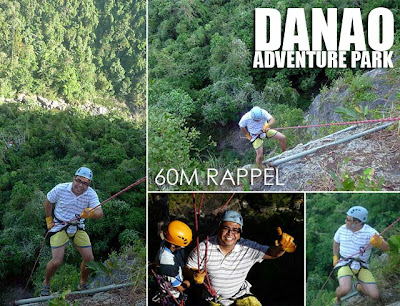
Then it was a challenging 60-meter rappel down the cliff. Don't worry about how to get up again since they have a motorized rope which hauls you back to the top. My arm accidentally hit the metal figure eight descender which gets really hot as you go down. So I had to contend with a minor burn. Others in the group hit the ropes which caused bigger burn marks in the stomach area, arms or neck. So you really have to be composed when rapelling down the cliff.

[danao8.jpg]

11/21/11

Adobo


Adobo (Spanish: marinade, sauce, or seasoning) is the immersion of raw food into a preparation, in the form of a stock (or sauce), of different components, including paprika (from red peppers), oregano, salt, garlic, and vinegar — mixed according to the place of origin and the food with which it is intended to be used—primarily to preserve and enhance the flavor of food. The cooking technique is native to Spanish cuisine,[1] and, once becoming widely used in Latin America, was subsequently adopted in other countries, such as the United States.[2]


Alternatively, in Venezuela, adobo refers to a mixture of salt with various spices, technically known as sal condimentada (seasoned salt).[3]

Lechon/Lechón

.


Lechón is a pork dish in several regions of the world, most specifically Spain and its former colonial possessions throughout the world. The word lechón originated from the Spanish termleche (milk); thus lechón refers to a suckling pig that is roasted. Lechón is a popular food in thePhilippines, Cuba, Puerto Rico, the Dominican Republic, other Spanish-speaking nations in Latin America, and Spain. The dish features a whole roasted pig cooked over charcoal. Nowadays in most of Latin America, the original use of a suckling pig has given way to a medium-sized adult pig.


In most regions, lechón is prepared throughout the year for any special occasion, during festivals, and the holidays. After seasoning, the pig is cooked by skewering the entire animal, entrails removed, on a large stick and cooking it in a pit filled with charcoal. The pig is placed over the charcoal, and the stick or rod it is attached to is turned in a rotisserie action. The pig is roasted on all sides for several hours until done. The process of cooking and basting usually results in making the pork skin crisp and is a delicious food

Philippine Flag


The national flag of the Philippines (Tagalog: Pambansang Watawat ng Pilipinas) is a horizontal flag bicolor with equal bands of royal blue and scarlet red, and with a white equilateral triangle at the hoist; in the center of the triangle is a golden yellow sun with eight primary rays, each containing three individual rays, which represent the country's provinces; and at each vertex of the triangle is a five-pointed golden yellow star, each of which, represent the country's 3 main islands, Luzon, Visayas and Mindanao. This flag can indicate a state of war if it is displayed with the red side on top.[1]

Kilawin


Kinilaw means to “cook” in vinegar. It’s not really cooking since there is no heat involved. But soaking fish or some other seafood in a strong vinegar solution turns the meat opaque and gives it a texture of having been cooked.
TASTE it and you won't FORGET it

11/11/11

Pacquiao VS Marquez


A lot of people are thinking that the Pacquiao vs Marquez fight this coming November 12 will not live up to its hype. Defeating the pound-for-pound king (Manny "Pacman" Pacquiao) is impossible to many people, but knowing Juan Manuel Marquez and watching his last two fights against him might give you doubts.

Boxing fans are aware that Marquez (nicknamed "Dinamita") has been announcing to the world that he won the last two fights against Pacquiao, even though he drew a draw in 2004 and was given a loss in the other bout in 2008.

I think that many people have scored the last two matches more in favor of Marquez than for Pacquiao.

In these two matches, one judge had favored Marquez because of his counter punching ability and capability to match his opponent's speed and skill.

Marquez is a very good counter puncher and he knows his way around Pacquiao. He has almost the same speed as the 8-world division champion. He is also very determined to end this trilogy with a win and quite knowledgeable on how Pacquiao moves in the ring.

Manny Pacquiao and his renowned coach Freddie Roach knows that’s why Pacman is training hard in order to knock down Marquez in the early rounds, which is quite impossible because JMM knows how to take a fight a bit far. That can be very disadvantageous to Pacquiao.

Going to the last rounds and eventually to the scoring cards might hurt Pacquiao’s career. He might experience a devastating loss against his arch rival. It will be very good for him to finish the fight as early as possible. But Marquez is also ready to not let that happen. He will move around, counter punch and fight with will for the fight to reach the 12-round end.

This will be a very good boxing match, a fight that can end the sour taste of what boxing has become. There is a great possibility that Marquez can pull the upset in his incoming boxing match but Pacquiao's skill and newly developed right hand skill can decide the match.

I bet that Pacquiao will end the match early for this fight and win.

So who's your bet? Who do you think will win this fight?

Tune in and watch the Pacquiao vs Marquez fight live on HBO Pay-Per-View this coming November 12, 2011, and be part of history.

General Santos City


I surely asure you that you will enjoy General Santos City! One of the most fastest rising city of the Philippines!


This City is popular about their Fish resources it is the TUNA capital of the philippines and a international exporter of Water Resources.


LOCATION
General Santos City is located in Region XI or Southern Mindanao, at the southernmost tip of the archipelago, with bearings 530' to 640' North Latitude and 12415' to 12545' East Latitude.

LAND AREA
GenSan (Gen. Santos) covers a total area of 536sq.km. Its terrain ranges from generally flat to gently undulating in the city and generally flat with scattered hills and isolated mountains in neighboring South Cotabato and Sarangani Province.


POPULATION and PEOPLE
In 2000 the city's population was placed at 411,822. Annual population growth rate is a high 5.1%, mainly due to in-migration to this booming area. Nearly all the ethnic tribes of the country, plus a number of expatriates, are represented in the area.

11/6/11

Puerto Princesa Underground River


The Puerto Princesa Subterranean River National Park is located about 50 kilometres (31 mi) north of the city center of Puerto Princesa, Palawan, Philippines. The National Park is located in the Saint Paul Mountain Range on the northern coast of the island. It is bordered by St. Paul Bay to the north and the Babuyan River to the east. The City Government of Puerto Princesa has managed the National Park since 1992. It is also known as St. Paul's Subterranean River National Park, or St. Paul Underground River. The entrance to the Subterranean River is a short hike from the town of Sabang. Puerto Princesa Subterranean River National Park is one of the 28 finalists for the "New Seven Wonders of Nature" competition.

There are 154 days left to vote for our very own Puerto Princesa Underground River in the New 7 Wonders of Nature.


No less than our President Benigno Aquino III appeals to Filipinos worldwide to vote for the Puerto Princesa Underground River in Palawan in the “New Seven Wonders of Nature” poll.


Located in what is considered “the last frontier”, the Puerto Princesa Underground River is the country’s lone contender in the global poll now being contested by 27 other official finalists from an initial list of 400 locations worldwide.


“Some 80 million Filipinos have cellular phones and some two billion text messages are sent every day. We only need a billion votes – that is just half a day of texting for all Filipinos who have cellular phones,” the President said.

2 WAYS TO VOTE:
1. Vote by telephone in three easy steps:
a.) Dial one of these international telephone numbers:
            +23 92201055      
            +1 869 760 5990      
            +1 649 339 8080      
            +44 758 900 1290      


b) At the end of the message, after the tone, insert the 4 digit code for your chosen nominee. The code for Puerto Princesa Underground River is 7723.


c) When you hear the thank you message, you are all done – you have voted by telephone!

11/2/11

Banaue Rice Terraces


the Philippines is blessed with many natural wonders. With tropical climate and lush vegetations, this archipelago is a destination you’ll never forget.
One of Philippines pride is the beautiful Banaue Rice Terraces. These man-made rice paddies were constructed about 2,000 years ago. The original Ifugao’s used their bare hands to build the stone walled mountain, one stone at a time.
This magnificent landscape is the main tourist attraction in Banaue. They have a lot of tourists who go out there to go trekking too. It’s perfect for hiking because of the slopes and the narrow rugged trails.

The carved out mountains looked like stairways going up the sky. It goes up to 4,900 feet high. It was said that if you put the steps side by side, from end to end, it would wrap halfway across the globe. It is truly a work of art, no wonder it was named as the 8th wonder of the World.


The lands are still being used today to plant their crops. The Ifugao’s only use organic fertilizers and natural pesticides gathered from the neighboring forest, just like their ancestors did many, many years ago.

Some areas of the rice terraces are showing signs of erosion. It needs maintenance. Some of the new generations Ifugao’s do not want to work in the farm anymore, so if it starts falling apart, they don’t know how to repair it. But despite of all of that, tourists still flock to see this wonderful work of mankind that never ceases to amaze.

If you’re planning a trip to the Philippines, make sure to include the Banaue Rice Terraces in your itinerary.

10/14/11

La Union


La Union, with its fine coastline that faces the South China Sea and its beautiful gardens, fell way behind in tourism after more popular tourist destinations like the Hundred Islands in Pangasinan, Palawan, Batangas, and Boracay gained more prominence in the past 10 years. Long before that, local tourists and American military servicemen from the nearby Wallace Air Station (which has now been converted into a business and industrial area to facilitate the economic activity in the region – with service, manufacturing, shipping, and agricultural areas spread all over La Union) trooped to the seedy beaches of Bauang for some good old rest and recreation (which is of course a euphemism for the prostitution boom) until 1991. And like the surrounding areas of the former US military bases in the Philippines like Subic and Clark – an unmistakable awkward vibe is felt in the air when discussions turn to anything that remotely mention the former American military presence in the area.

Philippines La Union
La Union
La Union, which is 6 hours north of Manila, was created by a Royal Decree issued by the Spanish Queen, Isabella, on 18 April 1854. The province was created from 9 towns of Pangasinan, 3 towns of Ilocos Sur and the villages of Eastern Pais del Igorotes that straddles the western foothills of the Cordilleras. The name of the province was, thus, derived from the union of these towns from the different provinces. Before the Spaniards came in 1572, La Union was already a bustling and important trading port, especially for gold, with Chinese and Japanese merchants present in the area.
The province made a big comeback though and literally made a big splash in the local and international surfing community as it is now one of the favored surfing sites in the Philippines after Siargao in Mindanao. The friendly swells of San Juan and Urbiztondo towns, with its equally amiable and well-established surfing community (surfing started in the ‘80s when foreigners started settling in these towns) is both best for the beginners with its beach breaks (San Juan Beach Break; Bacnotan with a right-hander) and reef breaks (a right-hander in Monaliza Point- popular among the locals, who can also be a bit territorial; Carille – features waves that can be up to 300 meters long and 15 foot high in best conditions) for the more advanced surfers and one of the most accessible surf spots if you are coming from Manila. There are two major surfing competitions – the Rimat Ti Amianan (Treasure of the North) in December, which is one of the important legs of the Philippine Surfing Federation Surf Circuit and draws top Filipino surfing talents, and the Mabuhay Longboarding Cup, an international surf event which is incidentally the longest running longboard competition in the Philippines.

Philippines La Union San Juan Surf
San Juan Surf
Photo by tristanjohn
The Billabong Cup also has an annual surf competition here – where Luke Landrigan, the most famous amongst the bunch rules the roost and one is of the co-founders of the United Pinoy Surfers. His Dad, Brian Landrigan, actually was among those credited of piquing the interests of the locals when he was amongst the first people to start catching the waves in this area in the early ‘80s. Luke eventually settled in the area and established the San Juan Surf Resort.
If you are a beginner surfer or simply want to learn the ropes of this fast-rising sport in the Philippine sporting scene – contact either Pj Valenciano (+63.9217.8607193), Yna Lozada (+63.917.8827583), Donna Valenciano (+63.917.8059011) or Gerard de Sagun (+63.927.7905149) of He’e Nalu Surfing Pinas. They organize surf camps to San Juan as well as in many other surf destinations in the Philippines like Baler in Aurora Province (Pacific Coast) and you can get taught to catch that wave by topnotch Philippine surfers themselves. Top surfers Daisy Valdes and Jefferson de la Torre had a lot of patience teaching us the basics of surfing and helping us to paddle out into the seas. Usually, you should be able to stand on the board and catch the wave in about 15 minutes (well, I guess I am a relatively fast learner – heh!). He’e Nalu Surfing Pinas is also the only surf group actively involved with the beach clean up.
If you plan to head out, please check with the group or with the Philippine Surfing Federation regarding the weather, and wave conditions. In some cases, the swells are not very reliable. San Juan Surf resort has a live cam feed, although it seems that it is not as updated as one would want and Global Surfari has a surf forecast resort (although this cannot be independently verified).
With the rise of La Union as an important surfing destination, comes the problem of waste. Good thing that Green Zinc Clean Shores spearheaded by Chris Sullivan, a non-profit organization aimed at protecting Philippine beaches, has started raising awareness not only amongst locals but with visiting surfers as well. In San Juan, a typical surf camp usually starts with a talk from one of the founders – Uffe Konig. Green Zinc also organize volunteers in beach cleanups – if you go to one of the surf camps – a beach cleanup is usually included in the itinerary – a sort of giving back to the community for every stoke that one experiences in its rolling surfs.
Aside from surfing, La Union is also known for its Botanical Gardens in San Fernando City which showcases different pavilions in its sprawling ten-hectare facility -a Fernery, Palmery, Fragrance Garden, Sunken Garden, Evergreen Garden, Arid Paradise, and a Shade Garden – with flora and fauna that are indigenous only to the Philippines. This offers a welcome respite from the humid and sometimes searing hot weather of the province.

Philippines La Union ma-cho temple
A beautiful Taoist Temple is another important tourist attraction in the province. Ma-Cho Temple, is located on a hill 70 feet above the sea level and offers commanding views of the bay. Coming from Manila, it is situated on your right, after you basically leave the San Fernando city centre on your way to San Juan. It was constructed on 11 September 1975 through the joint efforts of the local Chinese community. Ma-Cho, a revered Chinese deity was said to be born in 960 AD during the Sung Dynasty and according to a legend, she actively participated in the rescue operations of distressed fishermen, thus earning herself the titles, “Goddess of the Sea” and “Queen of Heaven” amongst others. The eight inch wooden statue has a striking similarity meanwhile to the “Virgin of Caysasay” who is enshrined at the Basilica of San Martin in Taal, Batangas and devotees believe that the two are one and the same. From 20th to 26th of September of each year, devotees and pilgrims gather for the annual celebration of enshrinement for a pilgrimage to the Basilica of Saint Martin in Taal, Batangas and from there, the devotees together with the image of Ma-Cho will travel back to San Fernando City and then a procession follows around the city centre. Similar temples can also be found in Malaysia, Taiwan, Singapore and many other countries with a sizable Chinese community (which basically goes without saying that they are everywhere).
For Catholics, La Union offers aged churches namely- Basilica of Our Lady of Charity (1578), Our Lady of Namacpacan (1600s-1800s), St. William Cathedral (1764), Sts. Peter and Paul Parish (1587), St. Michael the Archangel (1817) and St. John the Baptist (1707) and St. Christopher Parish (1696) – the only church in the Philippines with three belfries. Other attractions include the Balay Anito Falls which means House of Spirits, 4-5 kilometers from the main town of Santol. Apparently in early times, locals saw a ball of fire on this waterfall and thought these were spirits or “anitos” and “balay” means house, thus, the name. Lon-oy Springs in San Gabriel, La Union which consists of numerous natural springs, deep waterfalls and clear waters – Bakes Swimming Pool gets its water supply from these springs. Can’t make it to the rice terraces of Banawe or Sagada? The rice fields of Bolikewkew, Delles and Burgos provide a sneak peek of the big ones and serves as a hiking and trekking alternative. The Arosip Ecotrail reveals several waterfalls such as the Zim-zum-ug Twin Falls (one of the falls dried out as waters was redirected to the rice fields), Tekdag-aso Falls, and Padtok Falls.

Why Not Go


If you are looking for picture-perfect white sand beaches like Boracay (although there is a decent beach in San Juan and at Poro Point) or the rugged, misty mountain town of Sagada, then better pack your bags to those destinations – La Union does not have that.

Why Go


Philippines La Union
Need a surfing fix close to Manila? La Union is one of the best choices for you. The laidback and friendly surfing communities in these parts are some of the most chilled and relaxed weekend sports getaways in this part of Luzon Island.

Best Time to Visit


If you plan to go to surf – the North Swell usually starts around October until March (although beware as well, because this time is also notorious as being the jellyfish season and a lot of surfers get stung); while the South Swell arrives around late May to June until August. To catch better waves, check out the Philippine weather forecast by Philippine Atmospheric, Geophysical & Astronomical Services Administration – and for seasoned surfers, best time to ride the waves is when there are typhoons around the area. For other sites in La Union, it is best enjoyed during the dry season.