10/6/11

Puerto Galera

Puerto Galera is a soothing vision of shimmering seas surrounded by lush mountains. It is considered one of the most beautiful and developed beach resort community in the country.
Starting from "backyard tourism" wherein local residents accept local and foreign tourist as stay-in guest, the island’s tourism has flourished. In the course of time, several hotels, resorts, inns and restaurants have mushroomed within the area.
There are a thousand things one can do here. Landlubbers can pitch tents, light bonfires, play volleyball, toss a Frisbee, go beach-hopping, watch the sunset, gaze at the stars, hike, go rock climbing, carom off on a motorcycle, discover Oriental Mindoro’s other tourist spots or simply live it up.
But water is certainly the main attraction of the island. Crystal clear and shimmering especially during the hot summer months, the sea framing Puerto Galera is ideal for swimming, sailing, surfing, snorkeling and scuba diving. In fact one doesn’t have to go by boat to get to a dive site. Within a kilometer from the coast, schools of Moorish idols, trumpet fish, frog fish, lion fish and leaf fish weave in and out of thriving corals and sea anemones while species of starfish – from the speckled red-and-white to the neon-blue Pacific – rest on the sandy floor.

Anilao


Anilao, a resort village in Mabini, Batangas is considered the summer mecca of diving fanatics. The resort offers accommodations and diving facilities, plus the services of training clubs that provide courses on diving.

Situated in the southeast area of Batangas province, Anilao may be reached within three hours from Manila through public buses or jeepneys. From Anilao, one can start diving from the shore or go in bancas to nearby islands. Among them is Sombrero (Hat) Island, a marine preserve where sports activities are regulated.

Other dive spots in this side of Batangas are Mapating Rock at Maricaban Island, Caban Cove and Layag Layag Point.

The reason behind this is because Anilao is a marine protected sanctuary. The local government of Mabini and Tingloy and NGO's put together an effort to create a CRM Board or Coastal Resource Marine Board to chase out all activities of illegal fishing specially on dive sites and by maintaining good balance and protecting the different coral species from damage of anchoring banca boats and to educate local community in various ways of preserving this wonderful place.
Anilao is located south of Luzon Island and is approximately 140 km. away from Manila or 2.5 to 3 hours by car during normal traffic condition or depending on how you drive. Currently Anilao has more than 40 dive sites with about 5 to 10 minutes apart or 30 minutes the farthest point from any resorts. It has a wide variety of diving choices, from novices to instructors where you can see different species of corals, big pelagic fish or rare to find critters where on every dive you will surely be satisfied.
We have 2 full time Padi instructors and 1 assistant instructor and many Padi divemasters to render all the services you need in all aspects of scuba diving. It is also working together with some dive resorts in anilao to share the loads or let the guest choose their preferred resorts choices in terms of their capacity, life style or diving needs.

Subic Bay

Subic Bay is a bay forming part of Luzon Sea on the west coast of the island of Luzon inZambales, Philippines, about 100 kilometers northwest of Manila Bay. Its shores were formerly the site of a major United States Navy facility named U.S. Naval Base Subic Bay, it is now the location of an industrial and commercial area known as the Subic Bay Freeport Zone under theSubic Bay Metropolitan Authority (see also, Port of Subic).
Subic, the former US naval base in the Philippines, is now a hub for commerce and tourism. Just two-and-a-half hour drive north from Manila, Subic offers a full view of the blue mountain and sea and of the green background of a three-layered virgin forest.

Points of interest include the 18-hole Binictican Golf Course and Clubhouse, a white-sand beach, bowling and arcade center,a ship wharf past a restricted forested area, firing ranges, fishing grounds and an area for bungee jumping.

Visitors to Subic can take a 12-hour jungle survival course, visit an Aeta tribal village, take a bay cruise, explore the coves, end up at the white-sand beach of Grande Island, engage in water sports, go horseback riding or simply enjoy the scenic view of the sea.


Subic Bay is complete with tourism-support facilities that include a marina, a yacht club, hotels, shopping arcades and food shops. It also boasts of an international airport.

Shipwrecks of Subic Bay

The majority of the wrecks in Subic Bay are a result of either the Spanish–American War in 1898or of World War II, where a number of Japanese vessels were sunk by American aircraft.
El Capitan was a freighter of nearly 3,000 tons just under 130 meters long. She sank in Subic Bay where she rests on a sloping bottom.
Hell ship Oryoku Maru: On 15 December 1944, she had 1,619 American and British prisoners of war on board when she was sunk, under heavy bombardment by American fighters while on her way from Subic Bay to Japan. She was less than half a kilometer off the Alava Pier when attacked. About 300 prisoners died during the short voyage from Manila and during the attack.
Seian Maru: During an air raid on Subic Bay, the 3,712 ton freighter Seian Maru was bombed and sunk. This was only four days after the sinking of the Oryoku Maru on 19 December 1944.
LST (Landing Ship, Tank) This is one of the large LSTs that litter the floor of Subic Bay. She was scuttled in 1946 in the middle of Subic Bay between the southern tip of the runway and Grande Island.
The old USS New York (ACR-2), which had been renamed the USS Rochester (CA-2) in 1917. At the onset of the Japanese invasion of the Philippines, this ship was acting as a floating workshop and storehouse. Already decommissioned, the armored hull of the old cruiser was too valuable to allowed to be captured, and so she was scuttled in December 1941 by American forces.
San Quentin: During the Spanish–American war in 1898, the Spanish scuttled their San Quentin in the hope of blocking the passage between Grande Island and Chiquita Islands near the mouth of Subic Bay.

Mactan Cebu


Mactan Island lies across the Mactan Channel, opposite Cebu City in the southeast of Manila. It is modern and yet has retained its greenness and features lovely sandy beaches and good diving spots off the neighboring islets. Mactan has a long history with many stories, the most frequently told being about the Battle of Mactan. In 1521, when Portuguese-born explorer Ferdinand Magellan arrived onshore he was killed by Mactan Chief Lapu Lapu and his men.


Visitors can visit both the Magellan and Lapu Lapu shrines while visiting the island. Mactan is also important as home of Mactan – Cebu International Airport, the country’s second busiest airport as well as the country’s largest export processing zone. Mactan is also well known for producing guitars and other musical instruments.


Mactan is a perfect place for those who long for a holiday on a tropical island with beautiful beaches, great diving spots and plenty of snorkeling and diving sites. Mactan is part of Cebu Province where the Spanish first arrived and colonized the Philippines.
Besides being a paradise island with a modern living style, this island is home to two of the most important historical sites in the country; Magellan’s Marker and Lapu Lapu’s Shrine (also referred to as the Liberty Shrine).

Read more: Mactan Island Attractions - What to See in Mactan Island http://www.philippines-hotels.ws/mactan-island/attractions.htm#ixzz1Zz2ZT4eL

Magellan's Marker


Magellan’s Marker was built in 1866 and is located on the battleground where Mactan chief Lapu Lapu killed the Portuguese explorer Ferdinand Magellan in 1521. There are some shops and vendors selling souvenirs in the same area. Every year in April, there is a big anniversary with lots of entertainment at this park. No entrance fee.


Read more: Mactan Island Attractions - What to See in Mactan Island http://www.philippines-hotels.ws/mactan-island/attractions.htm#ixzz1Zz2jCTII

9/15/11

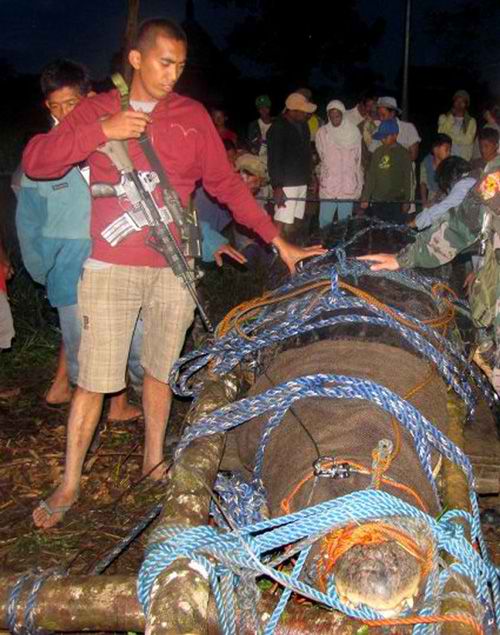
Biggest Crocodile!!! LOLONG!!!


A 21-foot (6.4-meter) male saltwater crocodile is now undercaptivity in Bunawan, Agusan del Sur which is located in the eastern part of Mindanao island in the Philippines. The crocodile is said to be the largest living of its kind in the world and is named “Lolong” in honor of the person who captured it.


According to reports, the crocodile will be transferred into an eco-tourism park but animal rights activists are urging the government to release the crocodile into the wilderness. Netizens debate whether it’s right to keep ‘Lolong’ in captivity. Below are some twitter and facebook reactions


They say LOLONG has a wife and much/more bigger than him, the goverment is planning to capture it for a short time, but they don't have enough equipment and facilities, This is a world record, the biggest crocodile ever, captured Alive! Thank to LOLONG a crocodile hunter who captured the crocodile, sadly the hunter died, but it is a great privilage for its family and whole country.